

Outsource Your Medical Billing and Kick Your Worries Away
Why Medical Practices Are Turning to Outsourcing for Billing Relief
Outsourcing medical billing services is when a practice partners with a specialized external company to handle all aspects of medical billing and revenue cycle management—from coding and claim submission to denial management and collections.
Key Benefits of Outsourcing Medical Billing:
- Cost Savings: Reduce billing costs by up to 30% by eliminating staff salaries, training, and software expenses.
- Revenue Growth: Practices typically see 10-24% revenue increases within months.
- Higher Clean Claim Rates: Achieve 95-98% first-pass clean claim rates vs. the industry average denial rate of 11.81%.
- More Time for Patients: Free up staff and providers from administrative burdens.
- Expert Compliance: Ensure adherence to complex Medicare, payer guidelines, and medical coding rules.
As a doctor, you face a unique challenge. You’re treating everything from diabetic foot ulcers to hammertoe corrections, but your billing department is drowning in complex CPT codes, modifier rules, and payer denials. One denied claim for wound care or custom orthotics can cost your practice thousands of dollars, not to mention the staff time spent on appeals.
The numbers tell the story. According to a 2024 report from MGMA, over 36% of physician practices now outsource part of their billing or coding to ensure compliance and accelerate reimbursements. In 2024, outsourced billing accounted for roughly 53% of total billing volume across all medical practices.
Why? Because medical billing isn’t just complex—it’s a specialty all its own. From gait analysis codes to diabetic foot care documentation requirements, your billing team needs expertise that goes far beyond general medical billing. When coding errors happen, the financial impact hits hard.
Outsourcing lets you hand off this specialized burden to experts who live and breathe medical billing codes. You get faster payments, fewer denials, and most importantly—more time to focus on what you do best: providing excellent patient care.
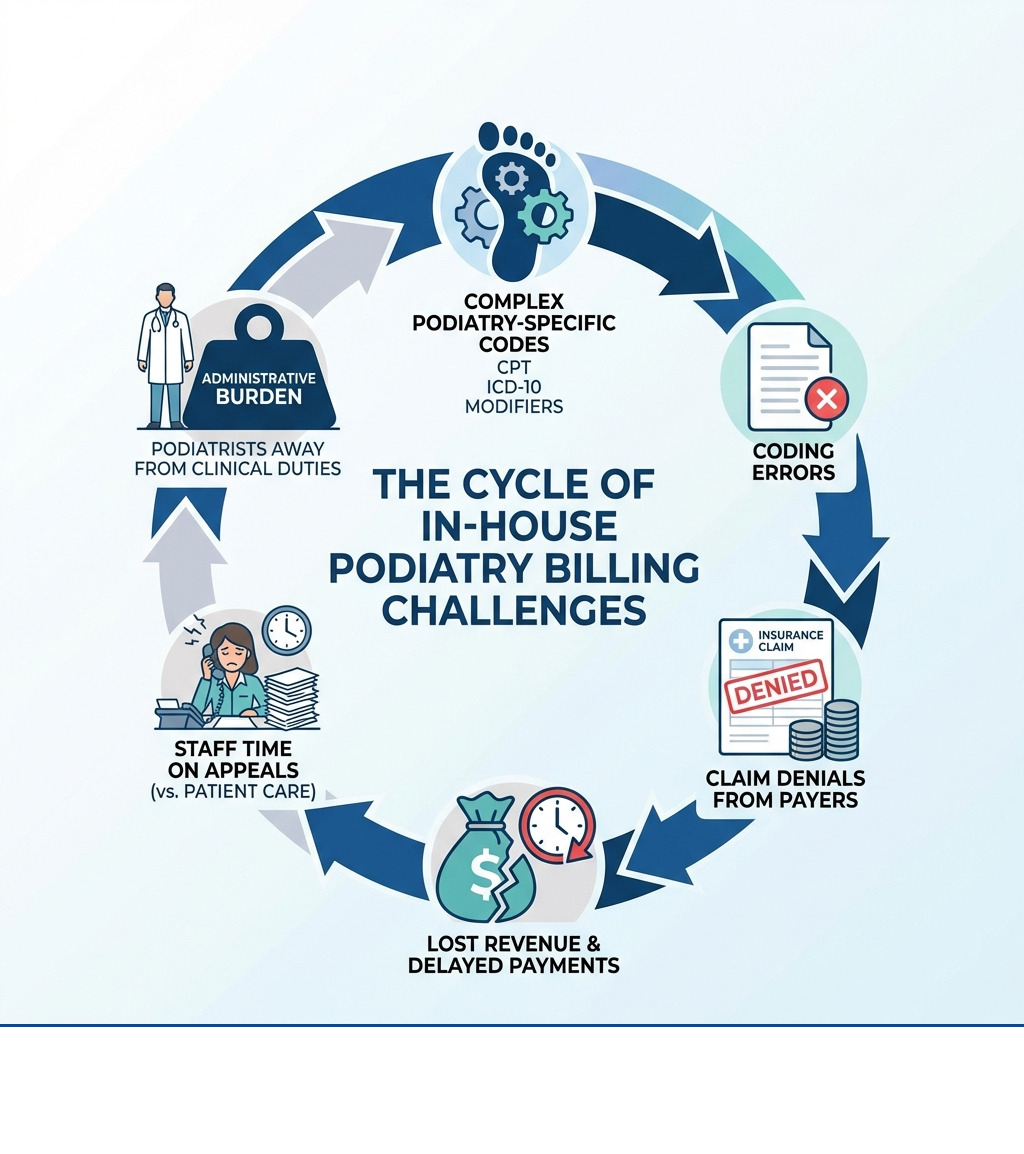
Why In-House Medical Billing Puts Your Practice at a Disadvantage
Running a medical practice is a delicate balance of clinical expertise and business acumen. While your passion lies in patient care, the administrative side, particularly medical billing, can become a significant drain. In-house billing, though seemingly convenient, often places your practice at a distinct disadvantage, leading to unique billing challenges, staff retention risks, costly overheads, and compliance struggles. It’s like trying to steer a complex maze blindfolded – you might get through, but with wasted effort and potential missteps.

The Unique Challenges of Podiatry Coding
Medical Billing is far more intricate than general medical billing. It demands a deep understanding of foot, ankle, and lower extremity health, along with specialized diagnostic and procedural codes. The nuances of medical billing coding can make or break a practice’s financial health.
Consider these specific areas where medical billing diverges:
- Diabetic Foot Care: Billing for diabetic foot care requires meticulous documentation to prove medical necessity. Medicare has stringent requirements for services like wound care, foot exams, debridements, and fitting diabetic shoes. Without precise coding and documentation, claims for these essential services can easily be denied.
- Wound Care Billing: Managing claims for wound care involves a specific set of CPT codes and often requires improved reimbursement strategies. Incorrect coding here can lead to significant revenue loss.
- Custom Orthotics and DME Billing: Billing for durable medical equipment (DME), including custom orthotics, involves its own unique codes, insurance rules, and reimbursement processes. It’s not uncommon for practices to face payment failures if these are not handled correctly.
- Surgical CPT Codes: Podiatric surgery, from bunionectomies to hammertoe corrections, involves complex surgical CPT codes. Understanding post-operative care and the correct application of modifiers is crucial for accurate reimbursement.
- Modifiers like -25 and -59: These are vital for clarifying services. The -25 modifier indicates a significant, separately identifiable E/M service on the same day as another procedure, while the -59 modifier distinguishes distinct procedural services. Misuse or omission can lead to denials and underpayment.
- Payer-Specific Rules: Each insurance payer has its own guidelines, coverage limitations, and preferred coding practices. Staying abreast of these ever-changing rules requires constant vigilance and specialized knowledge.
- Medical Necessity Documentation: For services like routine foot care, accurate documentation of medical necessity is paramount. Unless associated with a systemic condition like diabetes, routine foot care is often not covered. Proving this requires specific, detailed clinical notes.
These complexities highlight why outsourcing medical billing services to specialists is a strategic necessity. Without this specialized knowledge, your practice risks leaving money on the table and battling constant denials.
The Hidden Costs and Risks of In-House Billing
While keeping billing in-house might seem like a way to maintain control, it often comes with a hefty price tag and significant risks.
The direct costs alone can be substantial:
- Staff Salaries and Benefits: Employing a dedicated billing team means paying competitive salaries, health insurance, and other benefits.
- Training Expenses: Keeping your in-house billers updated on the latest medical coding guidelines and payer rule changes requires ongoing, costly training.
- Software and Infrastructure Costs: This includes purchasing and maintaining billing software, clearinghouse fees, and the necessary IT infrastructure.
Beyond these direct expenses, there are hidden risks and costs that can erode your practice’s profitability:
- High Denial Rates: In 2024, the average initial denial rate for medical claims climbed to 11.81%. For medical, coding errors can trigger additional denials, directly impacting your cash flow.
- Revenue Leakage: This occurs due to undercoding, missed charges, and inefficient follow-up on unpaid claims. A single denied claim can set a practice back thousands of dollars.
- Time Spent on Appeals: When claims are denied, your staff spends valuable time on appeals and resubmissions. This administrative burden distracts them from other crucial tasks and can lead to staff burnout.
- Compliance and Audit Risks: Keeping up with ever-changing payer edits, local coverage determination (LCD) policies, and federal regulations like HIPAA is a full-time job. A lack of specialized knowledge increases your risk of audits and potential penalties from bodies like the Centers for Medicare & Medicaid Services (CMS). According to the American Podiatric Medical Association (APMA), ensuring adherence to these guidelines is paramount.
- Staff Retention Issues: As highlighted in industry reports, in-house billing can be risky concerning staff retention. High turnover means continuous recruitment and training costs, further impacting efficiency.
These challenges illustrate how in-house billing can compromise your practice’s financial health, diverting resources and attention away from patient care.
The Transformative Benefits of Outsourcing Medical Billing Services
Imagine a practice where billing headaches disappear and your team can focus entirely on patient care. This is the reality for practices that choose outsourcing medical billing services. Partnering with a specialized billing service brings transformative benefits, from significant cost reduction and increased efficiency to expert knowledge and administrative relief.

Regain Focus on What Matters: Patient Care
The most profound impact of outsourcing your medical billing is the freedom it grants your practice to refocus on its core mission: patient care. When administrative burdens are lifted, the entire practice thrives.
- Reduced Administrative Tasks: Comprehensive outsourcing packages can handle everything from insurance verification and claims submission to denial management and patient collections. This dramatically reduces the administrative load on your in-house staff.
- More Time for Clinical Duties: With billing complexities expertly managed, your doctors and clinical staff can dedicate more time to diagnosing, treating, and interacting with patients. This means more thorough examinations and a higher quality of care.
- Improved Patient Satisfaction: When your staff is less stressed and more focused, patient interactions improve. Patients appreciate prompt responses to billing inquiries and a streamlined financial process, leading to a better patient experience and stronger loyalty.
- Better Work-Life Balance: The relentless pressure of in-house billing can contribute to stress for practice owners and staff. Outsourcing alleviates this pressure, contributing to a healthier work-life balance.
- Less Staff Burnout: By removing the frustrating and complex task of billing, you reduce the likelihood of staff burnout. A happier, less stressed team is more productive and engaged.
Outsourcing medical billing services allows your practice to operate at its highest potential, with every team member contributing optimally to patient well-being.
Achieve Significant Cost Savings and Efficiency
One of the most compelling reasons to outsource billing is the promise of substantial cost savings and increased operational efficiency, which translates into a healthier bottom line.
- Reduce Overhead by Up to 30%: By outsourcing, practices can cut billing costs by up to 30%. This saving comes from eliminating the need for in-house billing staff, their salaries, benefits, and associated overhead.
- Eliminate Billing Staff Salaries, No Software Investment, No Training Costs: Consider the expenses of an in-house billing department: annual salaries, ongoing training, and the recurring costs of billing software. Outsourcing removes these financial burdens.
- Streamlined Workflows: Specialized billing companies are built for efficiency. They use optimized workflows and advanced systems that can process claims faster and more accurately than most in-house operations.
- Claim Submission Within 24-48 Hours: Many specialized medical billing companies promise claim submission within 24 to 48 hours of receiving patient encounter data. This rapid turnaround is crucial for accelerating your revenue cycle and ensuring timely payments.
By leveraging expert support, your practice can achieve financial efficiencies that are difficult to replicate internally, allowing resources to be reallocated to patient care and practice growth.
How Outsourcing Boosts Your Revenue Cycle Management (RCM)
Effective Revenue Cycle Management (RCM) is the backbone of a financially healthy medical practice. For medical, where coding intricacies and payer rules are abundant, robust RCM is critical. Outsourcing medical billing services is a powerful strategy to boost your RCM, leading to improved cash flow, maximized reimbursements, and overall financial stability.
Drastically Reduce Claim Denials and Accelerate Payments
Claim denials eat away at revenue and consume valuable staff time. A specialized approach to outsourcing medical billing services is designed to tackle this challenge head-on.
- Expert Coders: Certified coders with an in-depth understanding of medical CPT, ICD-10, and HCPCS codes, as well as crucial modifiers like -25 and -59, are vital for accurately coding complex procedures like bunionectomies, gait analyses, and diabetic foot care.
- High First-Pass Clean Claim Rates: The goal is to achieve first-pass clean claim rates of 95% or higher. This means more claims are paid correctly on their initial submission, reducing the need for appeals. Some leading services report clean claim rates up to 98%.
- Proactive Denial Management: Rather than simply reacting to denials, strong billing partners work to prevent them. Effective processes include pre-submission alerts and robust denial management strategies. If a denial occurs, a trained team can act quickly for resolution.
- Faster A/R Turnaround: With fewer denials and efficient processing, your accounts receivable turnaround time significantly improves, leading to quicker payments and a healthier cash flow.
- Quicker Payment Cycles: By streamlining the entire billing process, practices can experience payment cycles that are up to three times faster. This acceleration is a game-changer for financial stability.
- Strategies for Medical Revenue Growth: Through expert billing and RCM, practices report significant revenue growth, often seeing increases of 10% to 24% within a few months.
Ensuring Bulletproof Compliance
Navigating the labyrinth of healthcare regulations is a daunting task. Non-compliance can lead to severe penalties and audits. When you partner with a reputable provider for outsourcing medical billing services, you gain an ally in ensuring bulletproof compliance.
- HIPAA Compliance: Patient data security is paramount. Strong billing partners adhere strictly to HIPAA regulations, employing end-to-end encryption and robust security measures. Many reputable firms provide annual SSAE 18 reports and sign Business Associate Agreements (BAA) to legally safeguard patient information.
- American Podiatric Medical Association (APMA) Guidelines: Specialized teams stay updated on the latest professional standards and guidelines from organizations like the APMA, ensuring your billing practices align with industry best practices.
- Medicare & Medicaid Regulations: Specialists are well-versed in the complex Medicare and Medicaid requirements for medical services, ensuring medical necessity is properly documented and claims are submitted in full compliance with CMS guidelines.
- Payer Policy Updates: Payer policies are constantly evolving. Certified coders and billers stay updated on all payer edits, local coverage determination (LCD) policies, and other regulatory changes to minimize errors and maximize reimbursement.
- Reduced Audit Risk: By ensuring accurate coding and thorough documentation, you can significantly reduce your practice’s risk of audits. This peace of mind allows you to focus on patient care without the constant worry of regulatory scrutiny.
- Mastering Medical Billing Compliance: True specialists are experts in the footwork of finance, mastering medical billing compliance to protect your practice and optimize your revenue.
Your Checklist for Choosing the Perfect Medical Billing Partner
Selecting the right partner for outsourcing medical billing services is a critical decision that will impact your practice’s financial health and operational efficiency. It’s about forming a strategic partnership that understands the unique demands of medical. Here’s a checklist to guide your choice.
Evaluating Expertise for Outsourcing Medical Billing Services
Specialized expertise is the cornerstone of effective medical billing.
- Certified Coders (AAPC): Look for a partner whose team includes certified coders, ideally with credentials from recognized bodies like the AAPC. This demonstrates a commitment to industry standards.
- Medical Experience: This is non-negotiable. Your billing partner must have a proven track record with niche medical services, including diabetic foot care, wound care, orthotics, and complex surgical procedures.
- Denial Management Strategies: Inquire about their specific strategies for preventing and managing denials. A robust system for appeals and resubmissions is key to maximizing revenue.
- Understanding of Complex Procedures: Ensure they have experience billing for the specific procedures your practice performs, such as bunionectomies, hammertoe corrections, and gait analyses.
- Questions to Ask a Potential Billing Partner: Use questions like these to evaluate fit:
- What is your typical first-pass clean claim rate for medical?
- How do your coders stay updated on the latest payer edits, LCD policies, and compliance regulations relevant to medical?
- What is your process for managing denied claims and appeals? Can you provide data on your success rate for appeals?
- How do you ensure accurate medical necessity documentation for routine foot care and diabetic foot care?
- What is your typical turnaround time for claim submission after receiving patient encounter data?
- How do you obtain patient visit details from our practice, and what is your process for seamless data transfer?
- How is patient data security maintained, including HIPAA compliance, encryption, and audit logs? Will you provide an annual SSAE 18 report and sign a Business Associate Agreement (BAA)?
- What kind of reporting and analytics do you provide, and how frequently? Can we customize these reports?
- Can we get references from other medical practices you serve in our region (New Jersey, Nevada, Nebraska, North Carolina, Kentucky)?
- What are your policies regarding contract flexibility and termination clauses?
Core Services and Technology to Look For
An effective billing partner offers a comprehensive suite of services and modern technology to optimize your entire revenue cycle.
- End-to-End RCM: Look for a partner that provides full-spectrum Revenue Cycle Management, including insurance verification, credentialing, claims submission, payment posting, denial management, and patient billing.
- EHR Integration: Seamless integration with your existing medical EHR system is crucial to avoid manual data entry errors and streamline workflows. Ask for a list of supported platforms.
- AI-Powered Tools: Modern billing services leverage technology, including AI, for tasks like pre-submission alerts on claims likely to be denied and interactive reminders for patient payments. This technology improves accuracy and efficiency.
- Real-Time Financial Dashboards: Access to intuitive, real-time dashboards is vital for tracking key performance indicators (KPIs) and monitoring your practice’s financial health.
Understanding the Cost Structure for Outsourcing Medical Billing Services
Cost is a significant factor, and transparency in pricing is key.
- Percentage of Collections Model: Most specialized medical billing companies charge a flat percentage, often from 5% to 10% of collected revenue. This model aligns the billing company’s success with your practice’s performance.
- Flat-Fee Options: While less common for full RCM, some services may offer flat fees for specific services or smaller practices.
- No Hidden Fees: Always clarify any potential additional costs such as setup or data migration fees. A reputable partner will be transparent about their pricing.
- Clear Contract Terms: Look for flexible contracts with clear termination clauses, ideally allowing for 30 to 60 days’ notice. This provides peace of mind and flexibility.
By diligently evaluating these criteria, you can confidently choose a medical billing partner that will serve as a true extension of your practice, ensuring financial success and allowing you to focus on exceptional patient care.
Frequently Asked Questions about Medical Billing
Making the switch to outsourcing medical billing services raises questions. Here are some common inquiries with our expert answers to provide clarity.
How quickly can I expect to see an increase in revenue?
Many practices report revenue growth of 10-24% within a few months by reducing denials and improving collection rates. This acceleration is a direct result of expert coding, proactive denial management, and efficient follow-up, which streamline your revenue cycle.
Will I lose control over my practice’s finances?
No, quite the opposite. Reputable partners provide transparent, real-time reporting and dashboards, giving you more insight and control than ever before. You’ll have access to detailed financial data and performance metrics, allowing you to monitor your practice’s financial health closely.
Can a billing service integrate with my current EHR system?
Yes, most top-tier services offer seamless integration with major medical EHR platforms to ensure a smooth workflow. This integration reduces manual data entry, minimizes errors, and ensures a consistent flow of information between your clinical and billing operations.
Conclusion: Step into a More Profitable and Patient-Focused Practice
The journey of a doctor is dedicated to healing, but the path to a thriving practice is often fraught with billing complexities and administrative burdens. As we’ve explored, in-house billing often leads to hidden costs, compliance risks, and a significant drain on your valuable time. The unique challenges of medical coding demand a level of expertise that general medical billing cannot provide.
By embracing outsourcing medical billing services, you’re making a strategic investment in your practice’s future. You gain access to specialized knowledge and streamlined processes that drastically reduce claim denials, accelerate payment cycles, and ensure bulletproof compliance. This translates directly into improved cash flow, maximized reimbursements, and significant cost savings.
The greatest benefit is the ability to regain your focus on what truly matters: providing exceptional patient care. Imagine a practice where your staff is liberated from billing headaches, your doctors can dedicate more time to clinical duties, and patient satisfaction soars. This isn’t just about financial health; it’s about fostering a better work-life balance and preventing staff burnout.
As your trusted partner in medical billing services, Guide Medical Billing Services offers specialized, 100% US-based billing and revenue cycle management for medical practices in New Jersey (Jersey City and Succasunna), Nevada (Las Vegas), Nebraska (Omaha), North Carolina (Charlotte), and Kentucky (Ashland). Our unique selling proposition is maximizing collections and streamlining operations through dedicated, medical expertise and personalized service.
It’s time to kick your worries away and step into a more profitable and patient-focused practice. Take the next step towards a brighter, more efficient future.
Contact Beacon to learn more about our specialized Billing Services.


