

Medical Practice management: 4 Pillars to Thrive
Why Medical Practice Management Matters More Than Ever
Medical Practice management is the foundation that determines whether your practice thrives or merely survives. As a doctor, you entered the field to heal patients—not to wrestle with billing headaches, staff scheduling conflicts, or compliance requirements. Yet effective practice management is what allows you to do exactly that: focus on patient care while maintaining a profitable, efficient operation.
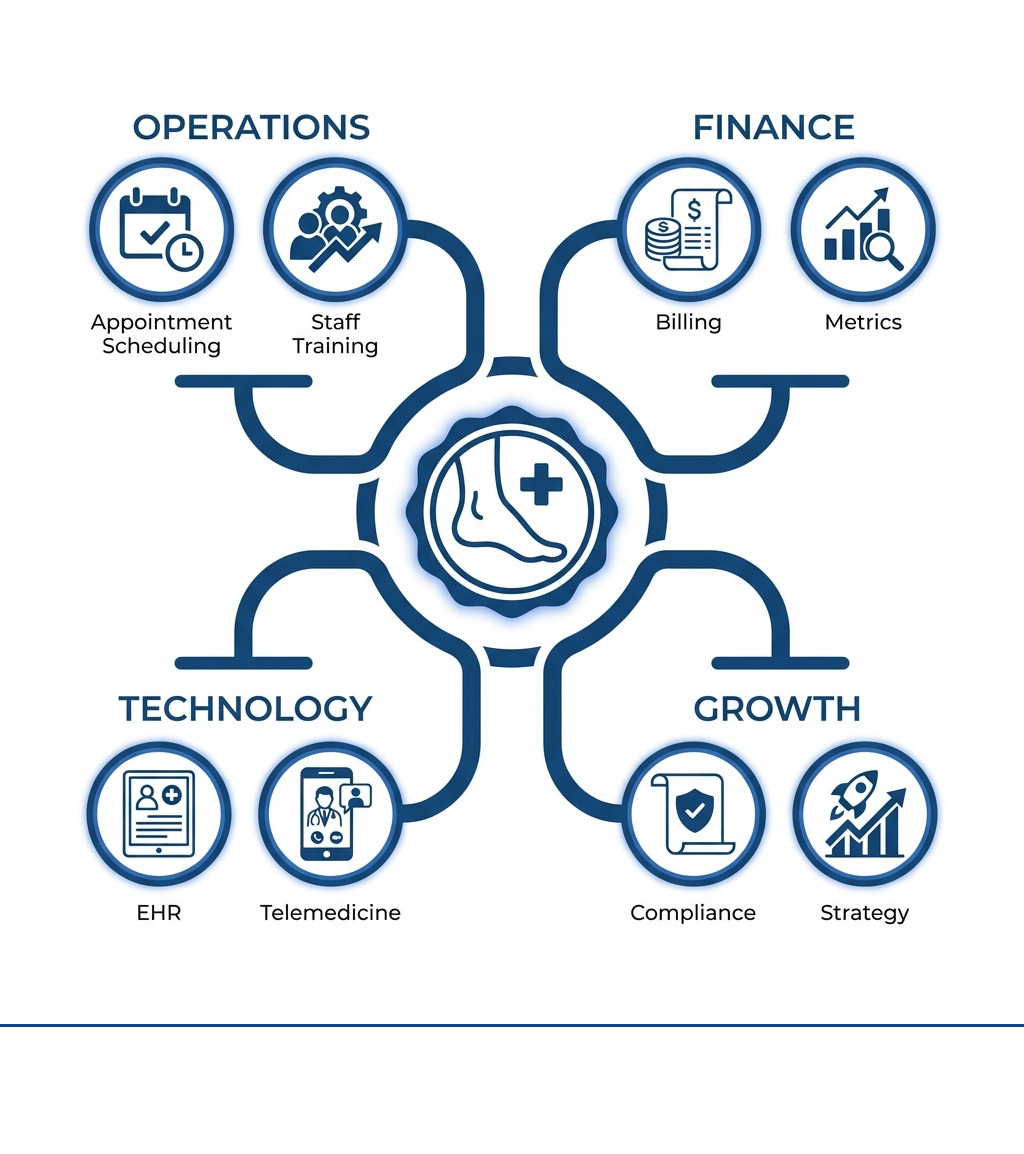
Core elements of successful medical practice management include:
- Operational efficiency – Streamlined scheduling, trained staff, and optimized patient flow
- Financial health – Accurate billing, monitored metrics, and strong revenue cycle management
- Technology adoption – Integrated EHR/PM software, telemedicine capabilities, and AI tools
- Regulatory compliance – HIPAA adherence, MIPS reporting, and state law compliance
- Strategic growth – Data-driven decisions, effective practice models, and risk management
According to Medical Management®, the premier practice management magazine reaching over 16,000 DPMs, medical practices face unique challenges across office management, coding, reimbursement, and patient relations. The American Academy of Podiatric Practice Management (AAPPM) has been helping doctors steer these complexities since 1961.
The landscape has evolved dramatically. Technology now plays a vital role in medical practices, with specialized software promising to increase revenue by up to 20% in 90 days. Yet many doctors still struggle with delayed payments, compliance risks, and administrative burdens that steal time from patient care.
This guide breaks down the essential strategies you need—from daily operations to financial oversight to technology integration—so you can build a practice that’s both clinically excellent and financially sustainable.
Streamlining Daily Operations for an Efficient Practice

Running a smooth medical practice is a bit like conducting an orchestra—every section needs to be in tune for a harmonious performance. Our goal is to ensure your daily operations run like a well-oiled machine, allowing us to dedicate more time to our patients and less to administrative woes. This involves optimizing everything from how we schedule appointments to how we manage our supplies and engage with our patients. For more insights on improving your practice’s daily flow, explore our resources on Practice Management & Growth.
Essential Components of Effective Medical Practice Management
What truly makes a medical practice tick? It’s a combination of interconnected components, each vital to the overall health and success of our operations. We’ve found that effective medical practice management hinges on:
- Optimized scheduling: Minimizing patient wait times and reducing no-shows are paramount.
- Staff development: A well-trained, knowledgeable team is our greatest asset.
- Patient communication: Clear, consistent, and empathetic interaction builds trust and loyalty.
- Financial oversight: Vigilant monitoring of revenue, expenses, and reimbursement ensures our financial stability.
- Regulatory compliance: Staying ahead of changing healthcare laws protects our practice from penalties.
- Technology integration: Leveraging the right tools, from EHR to telemedicine, can transform efficiency and patient care.
These elements work in concert to create a practice environment that is both productive and patient-centered.
Optimizing Appointment Scheduling and Patient Flow
One of the quickest ways to boost patient satisfaction and practice efficiency is by perfecting our appointment scheduling. No one enjoys long waits, and we certainly don’t enjoy empty slots! Here’s how we can keep our schedule humming:
- Advanced scheduling tools: These aren’t just fancy calendars; they can intelligently manage our daily flow, minimize patient wait times, and even suggest optimal booking times.
- Automated reminders: Implementing automated reminders via email, SMS, or phone calls is a game-changer. Studies show this drastically reduces patient no-shows, keeping our schedule full and our revenue predictable.
- Patient-friendly cancellation policies: Sometimes life happens! A clear, empathetic cancellation policy, coupled with efficient ways to fill those last-minute openings, is crucial.
- Waitlist features: When a slot opens unexpectedly, a smart waitlist feature can instantly notify patients eager for an earlier appointment, ensuring we maximize our billable hours.
By proactively managing our schedule, we improve patient satisfaction and make the most of every day.
The Crucial Role of Ongoing Staff Training
Our team is the heart of our practice, and investing in their growth is investing in our success. Ongoing staff training isn’t just a nice-to-have; it’s a critical component of effective medical practice management. It ensures our team is always up-to-date, confident, and capable of delivering exceptional care and service.
Here are the key training areas we should prioritize:
- Medical procedures: Ensuring everyone, from front-desk staff to clinical assistants, understands our specialized services.
- Patient interaction skills: Empathy, clear communication, and conflict resolution are vital for a positive patient experience.
- Billing and coding updates: With constant changes in CPT and ICD codes, regular training is essential to prevent costly errors and denials.
- HIPAA compliance: Protecting patient privacy is non-negotiable, and regular refreshers keep us compliant.
- EHR software proficiency: Maximizing our investment in technology means ensuring everyone can use our systems efficiently, from charting to scheduling.
Why is this so crucial? Well, a well-trained team means fewer errors, happier patients, and a more efficient workflow. It also fosters a positive work environment, reducing staff turnover and improving morale.
Enhancing Patient Engagement and Communication
Engaged patients are happier, healthier, and more loyal. Building strong relationships through effective communication is a cornerstone of medical practice management. It’s about making our patients feel valued and informed, not just treated.
- Personalized follow-ups: A quick call or message after an appointment shows we care.
- Educational materials: Providing clear, easy-to-understand information about their condition and treatment empowers patients to take an active role in their health.
- Online patient portals: These secure platforms allow patients to access records, schedule appointments, and communicate with our team, making their healthcare journey more convenient.
- Automated communication: Beyond appointment reminders, automated messages for preventive care or seasonal health tips keep us connected.
- Managing online reviews: Our online reputation is paramount. Actively monitoring and responding to patient reviews, both positive and constructive, helps us manage our image and address concerns promptly. As one expert noted, “Most rating sites are stacked against practitioners,” making proactive management even more important.
By prioritizing patient engagement, we foster a community of trust and continuous care.
Best Practices for Podiatry Inventory Management
Think of our supplies as the fuel for our practice engine. Running out of a critical dressing or a common orthotic can bring our operations to a screeching halt. Efficient inventory management is a quiet hero of medical practice management.
- Supply tracking: We need a robust system to track everything that comes in and goes out. This prevents overstocking (tying up capital) and understocking (disrupting patient care).
- Automated reordering: Setting minimum inventory levels and using software to automate reordering saves time and prevents stockouts. No more last-minute dashes to the supply store!
- Stockout avoidance: This is the ultimate goal. Knowing what we have, what we need, and when to order ensures we always have the right tools for the job.
- Managing durable medical equipment (DME): For items like diabetic shoes or custom orthotics, we can use templates to streamline processes, save time, and minimize audit risks.
- Cost-benefit analysis for supplies: Regularly reviewing our purchasing habits helps us identify cost savings without compromising quality. Group Purchasing Organizations (GPOs), for instance, can offer discounts on practice supplies and services.
Effective inventory management ensures we always have what we need, when we need it, without wasting precious resources.
Mastering Financial Health and Revenue Cycle Management

Let’s face it, keeping our practice financially healthy isn’t always the most glamorous part of our job, but it’s absolutely essential. This is where the rubber meets the road, ensuring we get paid for the excellent care we provide. Our financial health relies heavily on accurate billing, diligent monitoring of key metrics, and a robust revenue cycle management strategy. This is where Guide Medical Billing Services truly shines, offering specialized, 100% US-based billing and revenue cycle management for medical practices, maximizing collections and streamlining operations. To see how we can help optimize your financial processes, visit our Billing Services page.
Ensuring Accurate Billing and Coding
Accurate billing and coding are the bedrock of financial stability for any medical practice. Given the specificity of foot and ankle treatments, this can be complex, but getting it right means faster reimbursement and fewer denials.
- Medical CPT codes: Our team must be experts in the nuanced CPT (Current Procedural Terminology) codes unique to medical services. This includes everything from routine foot care to complex surgical procedures.
- ICD-10 accuracy: Precise ICD-10 (International Classification of Diseases, 10th Revision) coding ensures that the medical necessity of our services is clearly communicated to payers.
- Regular billing audits: We conduct regular internal audits to identify and correct any coding errors before claims are submitted. This proactive approach significantly reduces denials.
- Denial prevention: Utilizing automated billing software with built-in denial prevention tools can provide proactive, pre-submission alerts on claims likely to be denied. This saves us countless hours in appeals and resubmissions.
We understand the intricacies of medical billing and coding. For a deeper dive, check out The Foot-Friendly Guide to Medical Billing and Coding and learn more about Medicare Medical Billing Guidelines.
Key Financial Metrics Every Doctor Should Monitor
If we want to ensure the health of our practice, we need to know what to measure. Tracking key financial metrics provides invaluable insights into our practice’s performance, helping us make data-driven decisions.
- Accounts Receivable (A/R): This tells us how much money is owed to us. We aim for a low A/R, indicating quick payment.
- Collection rates: How much of what we bill are we actually collecting? A high collection rate means our billing efforts are effective.
- Days in A/R: This metric indicates the average number of days it takes to collect payments. Lower is better!
- Net collection ratio: This ratio helps us understand the effectiveness of our collections after contractual adjustments.
- Patient acquisition cost: Knowing how much it costs to bring in a new patient helps us evaluate our marketing strategies.
Other important metrics include charges, payments, adjustments, and staff productivity. Regularly reviewing these benchmarks, often following MGMA (Medical Group Management Association) recommendations, helps us identify cost-saving opportunities and areas for improvement. For more on tracking your practice’s financial pulse, read our guide: Live and Die by KPIs: The Doctor’s Guide to Practice Growth and Profitability and explore Financial Health KPIs.
Strategies for Adequate Service Compensation
We work hard to provide exceptional care, and we deserve to be compensated fairly for our services. This often requires proactive strategies, especially when dealing with complex cases or services outside the traditional office visit.
- Hospital call compensation: Doctors often provide crucial services in hospital settings, yet compensation can be a sticking point. As Medical Management Online highlights, our services are important and should be compensated. We need clear agreements and proper coding to ensure we’re paid for these essential calls.
- Coding for complex conditions: When dealing with intricate foot and ankle conditions, using the correct HCPCS (Healthcare Common Procedure Coding System) add-on codes is vital for accurate reimbursement. This ensures we’re compensated for the full scope of our expertise.
- Understanding payer policies: Each insurance payer has its own labyrinth of rules. Staying informed about their specific policies, prior authorization requirements, and appeal processes is critical.
- Negotiating contracts: Periodically reviewing and negotiating our contracts with payers can ensure our reimbursement rates remain competitive and fair.
- Patient responsibility estimation: Using tools that estimate a patient’s out-of-pocket costs upfront can reduce surprises and improve patient satisfaction, leading to smoother collections.
Navigating these complexities can be daunting, but with the right expertise, we can ensure our practice thrives. Find how to find the right partner to help with these strategies in 5 Proven Ways to Find a Medical Billing Company.
Leveraging Technology in Modern Medical Practice Management
In today’s healthcare world, technology isn’t just an advantage—it’s a necessity. From managing patient records to delivering remote care, integrating the right technological solutions is fundamental to modern medical practice management. It helps us work smarter, not harder, and ultimately improves the care we provide. For more on how technology can transform your practice, visit our insights on Technology in Medical.
Best Practices for Medical Practice Management Software
The right EHR (Electronic Health Record) and practice management (PM) software can be our practice’s best friend. These integrated systems are designed to streamline nearly every aspect of our operations, specifically custom for the unique needs of medical.
- Workflow automation: Imagine automated check-ins that reduce administrative tasks and free up our front desk staff. This software can handle everything from eligibility verifications to interactive appointment reminders, letting our team focus on patient care.
- Centralized patient data: All patient information, from medical history to billing details, is stored in one secure location, improving data accuracy and accessibility.
- Medical templates: Our software should come equipped with templates for common medical conditions like bunions, diabetic foot care, plantar fasciitis, and ingrown toenails. This streamlines documentation, making charting faster and more accurate.
- Reporting and analytics: Robust reporting tools provide valuable insights into our practice’s performance, from clinical outcomes to financial KPIs, helping us make informed decisions.
- Voice-navigable charting: Advanced systems can even offer voice-navigable charting, allowing us to document hands-free and streamline our clinical workflow even further.
The benefits are clear: improved efficiency, improved patient experience, and a stronger bottom line. If you’re considering a change or an upgrade, our guide, Navigating Your Transition from TrakNet: Find Your Perfect EHR Match with Beacon, can help you find the perfect fit.
Integrating Telemedicine into Your Medical Practice
Telemedicine has moved beyond a temporary solution; it’s now a vital component of accessible and efficient patient care in medical. It allows us to extend our reach and improve patient convenience, especially for those in New Jersey, Nevada, Nebraska, North Carolina, and Kentucky.
- Follow-up consultations: Many post-operative checks or medication adjustments can be handled virtually, saving patients a trip to the office.
- Triage for minor issues: For new patients or those with minor concerns, a quick telemedicine consult can help us determine the best course of action without them needing to come in physically.
- Expanding patient reach: Telemedicine breaks down geographical barriers, allowing us to serve patients who might otherwise struggle to access our specialized care.
- Reducing no-shows: The convenience of a virtual visit can significantly reduce no-show rates, as patients are more likely to attend appointments from the comfort of their homes.
By offering telemedicine, we can expand our reach, reduce no-shows, and improve patient convenience. For further insights into telemedicine benefits, check out this trusted resource on telemedicine adoption.
The Growing Role of AI and Imaging Integration
Artificial Intelligence (AI) and integrated imaging solutions are revolutionizing medical practice management, offering unprecedented opportunities for improved diagnosis, treatment planning, and operational efficiency.
- AI in diagnostics: While still evolving, AI can assist in analyzing imaging scans, detecting subtle anomalies, and even predicting patient outcomes, offering a powerful second opinion.
- AI for administrative tasks: AI-powered tools can automate tasks like natural language data capture in EHRs, streamline scheduling, and even help with patient acquisition, freeing up our team for more direct patient interaction.
- Streamlined diagnosis: Integrating imaging solutions directly with our EHR system means X-rays, MRIs, and other diagnostic images are immediately accessible during patient consultations. This speeds up our diagnostic process and allows for more informed treatment planning.
- Improved treatment planning: With all relevant imaging and patient data at our fingertips, we can develop more precise and personalized treatment plans. For Medicare patients, clinical decision support mechanisms for imaging orders ensure compliance and appropriate utilization.
- Data analysis for patient outcomes: AI and advanced analytics can sift through vast amounts of patient data to identify trends, evaluate treatment effectiveness, and continuously improve our care protocols.
The integration of these technologies empowers us to provide higher quality care, faster, and with greater accuracy.
Strategic Growth, Compliance, and Risk Management
Growing a medical practice isn’t just about seeing more patients; it’s about strategic planning, meticulous compliance, and proactive risk management. The healthcare landscape is constantly shifting, and staying informed is key to long-term success. We often look to resources like the APMA Practice Management page for guidance. For specific insights into navigating the legal complexities, our Compliance & Legal section offers valuable information.
Navigating Healthcare Regulations and Compliance
Compliance isn’t just a buzzword; it’s our shield against hefty penalties and a cornerstone of ethical medical practice management. Healthcare regulations are constantly evolving, and we must stay vigilant.
- HIPAA rules: Adhering to HIPAA Privacy and Security rules is non-negotiable. Protecting patient information is our legal and ethical responsibility.
- Stark Law: Understanding and complying with the Stark Law, which prohibits physician self-referrals, is crucial to avoid legal complications.
- MIPS reporting: For Value-Based Care initiatives like MIPS (Merit-based Incentive Payment System), we need to ensure accurate data collection and reporting to avoid penalties, which can be up to 9% for lack of reporting. Many advanced EHR systems automatically cull the required data, simplifying this process.
- Medicare regulations: Medicare guidelines, including Conditions of Participation, are complex. We need to stay informed about coverage criteria and billing rules to ensure proper reimbursement.
- State laws: Beyond federal regulations, we must also adhere to specific state laws and regulations pertinent to medical medicine in New Jersey, Nevada, Nebraska, North Carolina, and Kentucky.
Regular training, internal audits, and even compliance software can help us manage documentation and ensure our policies align with current laws. To ensure your practice is audit-proof, refer to our guide: Audit-Proof Your Practice: A Guide to Medical Billing Compliance.
Choosing a Practice Model: Solo, Group, and Direct Care
The model we choose for our practice significantly impacts our daily life, financial stability, and patient relationships. There are distinct advantages and disadvantages to solo, group, and direct care models.
| Feature | Solo Practice | Group Practice | Direct Care Practice |
|---|---|---|---|
| Financial Freedom | High, but with full personal financial responsibility | Shared, potentially higher income due to scale, but shared decisions | High, direct patient payments, predictable revenue |
| Administrative Burden | Very High, all tasks fall to the owner | Shared among partners, specialized staff can handle tasks | Reduced, no insurance billing, focus on patient care |
| Work-Life Balance | Challenging, long hours, always “on call” | Potentially better, shared call schedules and coverage | Improved, fewer administrative tasks, more control over schedule |
| Patient Relationships | Deep, highly personalized, strong loyalty | Personalized, but may see different providers within the group | Very strong, focus on quality time, no insurance interference |
| Reduced Stress | Low, high pressure | Medium, shared responsibilities | High, freedom from insurance hassles, improved patient relationships |
| Startup Costs | Moderate to High | Moderate (shared) | Moderate (less need for extensive billing infrastructure) |
Converting to a direct care practice, for instance, can reduce stress, improve patient relationships, and offer greater financial freedom by removing the complexities of insurance billing. However, it requires a different patient acquisition strategy and a willingness to step outside traditional models.
Managing Legal Risks and Professional Development
As doctors, we face unique legal and professional challenges. Proactive management of these risks is crucial for the long-term viability and reputation of our practice.
- Supervising Advanced Practice Providers (APPs): If we supervise Physician Assistants (PAs) or Nurse Practitioners (NPs), we must be acutely aware of the legal and financial risks. We always check with our state’s licensing board in New Jersey, Nevada, Nebraska, North Carolina, and Kentucky to understand the specific regulations and liabilities associated with supervising APPs. Vicarious liability, where we can be held responsible for their actions, is a significant concern.
- Medical malpractice elements: Understanding the four elements of medical malpractice—Duty, Breach of Duty, Causation, and Damages—is fundamental. Thorough documentation provides our best defense, especially in areas like wound care, which are often subject to Medicare audits.
- Buying a practice: If we’re looking to acquire an existing practice, there are many starting concepts to consider, from due diligence to valuation and legal structuring. This is a significant professional step that requires careful planning.
For continuous professional development and to stay informed on these critical topics, we regularly consult resources like Medical Management Online.
Conclusion
Effective medical practice management isn’t a one-time fix; it’s a journey of continuous improvement. By embracing an integrated approach that prioritizes operational efficiency, financial stability, and patient-focused care, we can build a resilient and thriving practice. From optimizing daily workflows to leveraging new technologies and staying compliant with ever-changing regulations, every strategic step contributes to our success.
Our commitment to our patients is unwavering, and robust practice management ensures we can continue to provide the highest standard of care without being bogged down by administrative burdens. For practices looking to perfect their revenue cycle and reduce administrative complexities, partnering with a specialist like Guide Medical Billing Services can be a transformative step. Find how our dedicated medical billing services can help you achieve your practice goals, allowing you to focus on what you do best: healing feet.


