

The Doctor’s Codebook: Navigating Billing and Procedure Codes
The Essential Role of Medical Billing Codes
Understanding medical billing codes is critical for any modern foot and ankle specialist. These codes are the language your practice uses to communicate with insurance companies for proper reimbursement.
Here are the core types of codes you’ll encounter:
- CPT (Current Procedural Terminology) Codes: These describe the specific medical services and procedures your practice performs.
- ICD-10 (International Classification of Diseases, 10th Revision) Codes: These explain the patient’s diagnosis or medical condition that justifies the services.
- Modifiers: These are special additions to CPT codes that provide extra details about a service or procedure, telling payers why a service was necessary or if something unusual occurred.
The U.S. medical services market is projected to reach $5.1 billion by 2030. This growth means more patients and more billing. Accurate coding is vital not just for getting paid, but for ensuring your practice stays financially healthy by avoiding denied claims and keeping revenue flowing smoothly.
Navigating CPT, ICD-10, and modifiers can seem daunting, but mastering them is key to your practice’s success and ensures you get paid fairly for the excellent care you provide.
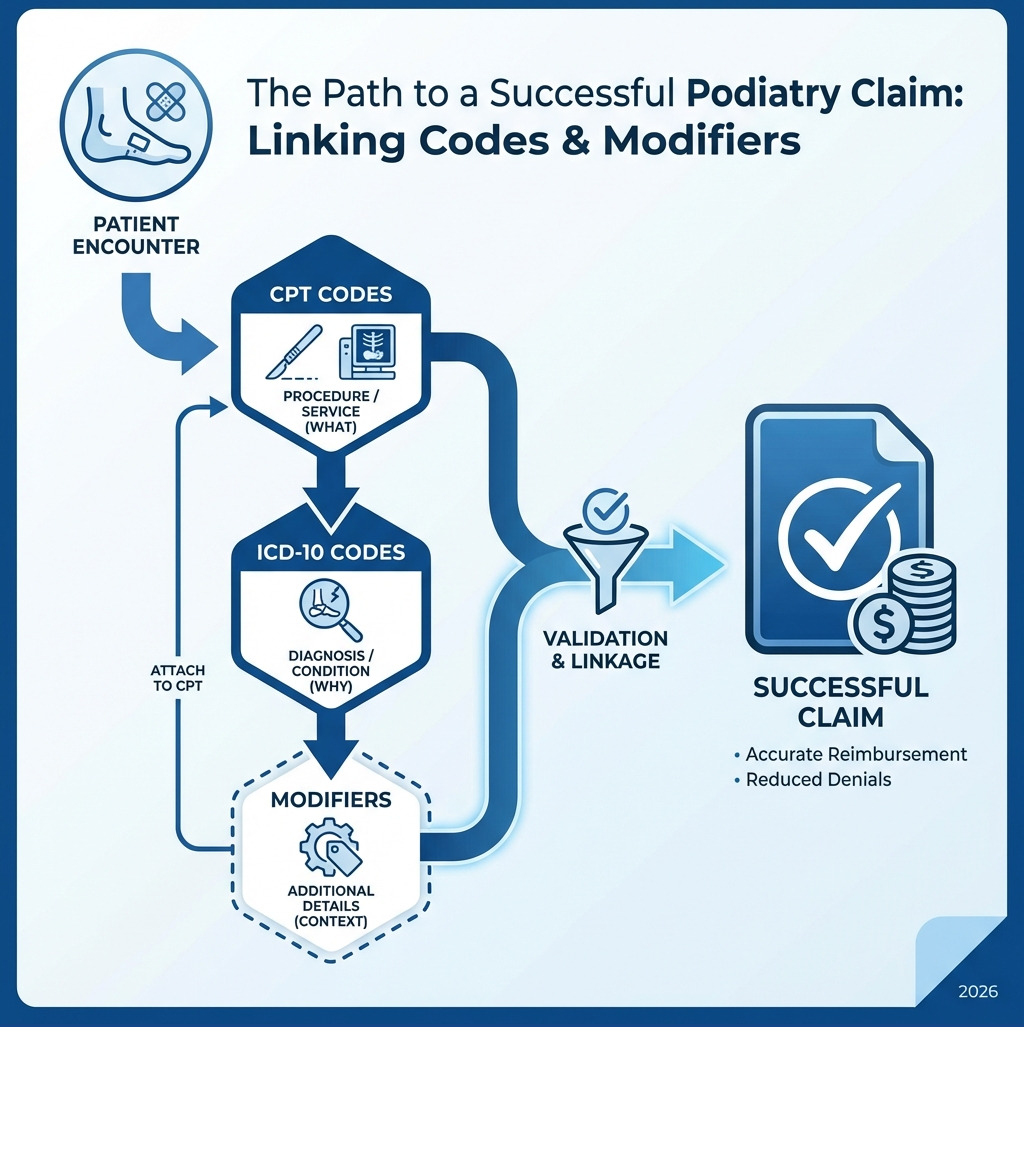
Key terms for medical billing codes:
The Foundation of Podiatry Coding: CPT, ICD-10, and Modifiers
In healthcare, precise communication is paramount. For medical practices in New Jersey, Nevada, Nebraska, North Carolina, and Kentucky, this communication happens through a standardized language of codes that form the bedrock of your practice’s financial health.

This system relies on CPT, ICD-10, HCPCS Level II codes, and modifiers, which work together to create a complete claim.
- CPT (Current Procedural Terminology) Codes: Maintained by the AMA, these five-digit codes describe the medical, surgical, and diagnostic services you perform. They tell payers what you did. Learn more from the AMA’s CPT overview.
- ICD-10 (International Classification of Diseases, 10th Revision) Codes: These alphanumeric codes describe a patient’s diagnosis or symptoms. While CPT codes tell payers what you did, ICD-10 codes tell them why you did it, establishing medical necessity.
- HCPCS Level II Codes: These codes cover services, supplies, durable medical equipment (DME), and drugs not included in CPT, such as orthotics or certain medical supplies.
- Modifiers: These two-digit additions append to CPT or HCPCS codes to provide clarification. They indicate that a service was performed differently or that specific circumstances applied, which is crucial for preventing denials.
The cornerstone of successful billing is demonstrating medical necessity. Every service must be justified by the patient’s diagnosis. Payer guidelines, especially from Medicare and major private insurers, dictate what services they cover. Our team at Guide Medical Billing Services understands these nuances, ensuring your claims meet these stringent requirements. Mastering this foundation is part of The Footwork of Finance: Mastering Medical Billing Compliance.
The Role of Systemic Conditions in Coverage
Systemic conditions can transform what might be considered “routine” foot care into a medically necessary service. For example, over 38 million Americans have diabetes, and up to 34% will develop a foot ulcer, which can lead to amputation if untreated. This underscores the need for proactive medical care. Similarly, Peripheral Vascular Disease (PVD) significantly impacts circulation, making patients highly susceptible to foot complications.
When billing for these patients, linking the appropriate ICD-10 code for the systemic condition (e.g., E11.40 for diabetes with neuropathy or I70.2 for PVD) to your CPT codes is essential. This linkage justifies the medical necessity, demonstrating to the payer that the services are crucial to prevent more severe health issues. This intricate connection is explored in Footing the Bill: A Doctor’s Handbook to CPT and ICD-10 Codes.
Understanding Q Modifiers for At-Risk Foot Care
For routine foot care for high-risk patients, Medicare requires “Q” modifiers to justify coverage for services that might otherwise be considered non-covered.
- Q7 Modifier (One Class A finding): Used when the patient has a nontraumatic amputation of the foot or part of the foot.
- Q8 Modifier (Two Class B findings): Signifies two Class B findings, which relate to systemic conditions (metabolic, neurological, or PVD) impacting circulation or sensation. Examples include absent pulses, decreased sensation, or trophic changes (e.g., hair loss, nail changes, thin skin). Medicare often covers nail debridement (11721) with this modifier.
- Q9 Modifier (One Class B and two Class C findings): Used with one Class B finding and two Class C findings. Class C findings are localized issues like edema, redness, ulceration, or paresthesias.
Accurate application of these modifiers, coupled with robust documentation, is essential for demonstrating medical necessity and securing reimbursement. For detailed guidance, refer to resources like Billing and Coding: Routine Foot Care (A56680).
Mastering Common Medical Billing Codes by Service Type
Navigating the multitude of CPT codes in medical is more manageable when broken down by service type. For practices in New Jersey, Nevada, Nebraska, North Carolina, and Kentucky, staying on top of these codes, their nuances, and annual updates is key to a healthy revenue cycle.

Essential medical billing codes for Routine Foot Care
Routine foot care presents complex billing challenges due to strict medical necessity rules, especially from Medicare. These services typically involve nail care and the treatment of corns and calluses.
Here are key medical billing codes for routine foot care:
- Nail Debridement (11720, 11721): For debridement (trimming, grinding) of nails.
- 11720: Debridement of 1 to 5 nails.
- 11721: Debridement of 6 or more nails. Medicare may cover this up to six times a year with a qualifying systemic condition and the correct Q modifier.
- Nail Trimming (11719, G0127):
- 11719: Trimming of nondystrophic (healthy) nails, any number.
- G0127: Trimming of dystrophic (thickened, brittle) nails, any number.
- Important Note: Do not bill codes like 11719 and 11720 together for similar services. Choose the most appropriate code based on the service and payer.
- Corns and Calluses (11055, 11056, 11057): For paring or cutting benign hyperkeratotic lesions.
- 11055: Single lesion.
- 11056: Two to four lesions.
- 11057: More than four lesions.
Documentation for Medical Necessity: For Medicare, detailed documentation is crucial. You must link the service to a systemic condition (e.g., diabetes, PVD) with the correct ICD-10 codes and apply the appropriate Q modifiers (Q7, Q8, or Q9) to prove medical necessity. Without this, claims for routine care will likely be denied. Our guide, Demystifying Medicare: What’s Covered, When, and How to Calculate Costs, offers more detail.
Key medical billing codes for Minor Procedures
Minor medical procedures require precise coding and modifier usage for proper reimbursement.
Here are essential codes for minor procedures:
- Nail Avulsion (11730, 11732): For removal of a nail plate, often for ingrown toenails.
- 11730: Avulsion of nail plate, partial or complete; single.
- 11732: Each additional nail plate.
- Crucial Modifier: Always include laterality modifiers (-LT for left, -RT for right).
- Injections (20550, 20551): For therapeutic injections.
- 20550: Injection(s); single tendon sheath, or ligament, aponeurosis (e.g., plantar fascia).
- 20551: Injection(s); single tendon origin/insertion.
- Lesion Removal (17110): For destruction of benign lesions.
- 17110: Destruction of up to 14 benign lesions (e.g., by cryosurgery, laser).
Modifier -25 for Same-Day E/M: If you perform a significant, separate E/M service (patient visit) on the same day as a minor procedure, you must append modifier -25 to the E/M code. This tells the payer the E/M service was distinct from the procedure, preventing it from being denied as part of a “bundle.”
Advanced Codes for Podiatric Surgical Procedures
Podiatric surgery demands meticulous documentation and adherence to global surgical packages.
Common surgical medical billing codes include:
- Hammertoe Repair (28285): Correction, hammertoe (e.g., interphalangeal fusion, phalangectomy).
- Bunion Surgery (Hallux Valgus Correction):
- 28292: Correction with proximal metatarsal osteotomy.
- 28297: Correction with distal metatarsal osteotomy.
- Tendon and Bone Procedures:
- 27650: Repair, primary, Achilles tendon.
- 28119: Osteotomy, calcaneus (e.g., for Haglund’s deformity).
- 28740: Arthrodesis, midtarsal or tarsometatarsal, single joint.
Documentation is Essential: Surgical procedures require comprehensive operative notes detailing the approach, findings, procedures, and any implants used. Clear pre- and post-operative diagnoses are also vital.
Global Surgical Packages: Most surgical codes include a “global package” covering pre-operative visits, the surgery, and post-operative care for a set period (e.g., 90 days). Billing for separate E/M services within this period requires specific modifiers and strong justification.
Pre-authorization: Many surgical procedures require prior authorization from the insurer. Failing to obtain this can result in claim denial.
Coding for Patient Visits: Evaluation and Management (E/M) Services
Beyond procedures, a doctor’s work involves patient visits, known as Evaluation and Management (E/M) services. Correctly coding these visits for diagnosing conditions and developing treatment plans ensures you’re reimbursed for your time and expertise.
E/M codes are categorized by patient status (new or established) and visit complexity.
- New Patients: Patients who haven’t received services from you or a same-specialty physician in your practice within the last three years.
- 99202: 15-29 minutes, straightforward medical decision making (MDM).
- 99203: 30-44 minutes, low MDM.
- 99204: 45-59 minutes, moderate MDM.
- 99205: 60-74 minutes, high MDM.
- Established Patients: Patients who have received services from you or a same-specialty physician in your practice within the last three years.
- 99212: 10-19 minutes, straightforward MDM.
- 99213: 20-29 minutes, low MDM.
- 99214: 30-39 minutes, moderate MDM.
- 99215: 40-54 minutes, high MDM.
Criteria for Selecting Higher-Level Codes: The E/M code level is determined by either the Medical Decision Making (MDM) or the total time spent on the encounter date.
- Medical Decision Making (MDM): This is often the primary driver. It considers the complexity of problems addressed, data reviewed, and the risk of complications from patient management.
- Time-Based Billing: For outpatient E/M services, you can select the code based on the total time spent by the provider on the encounter date. This includes face-to-face and non-face-to-face time (e.g., reviewing records, documenting).
2023 E/M Changes: Significant changes in 2023 simplified documentation for office and outpatient E/M services. The focus shifted from counting history/exam elements to MDM or time as the key factors for code selection.
Documenting E/M Level: Whether using MDM or time, your clinical notes must clearly support the chosen E/M level. This includes detailing the patient’s history, assessment, plan, and the complexity of the MDM or total time spent. Staying updated with Billing & Coding Updates is essential for compliance.
Audit-Proofing Your Practice: Avoiding Common Billing Pitfalls
Even with a solid understanding of medical billing codes, pitfalls can lead to denials, delayed payments, and audits. For practices from Jersey City to Las Vegas, avoiding these common errors is crucial for financial stability.
Common pitfalls include:
- Missing Documentation: The most frequent culprit. If notes don’t clearly support the medical necessity of a service (e.g., linking ICD-10 to CPT, justifying Q modifiers), the claim will likely be denied.
- Incorrect Modifier Usage: Improper use of modifiers like -25, -59, or the Q modifiers can lead to denials or accusations of unbundling.
- Bundling Issues: Billing separately for a service that the National Correct Coding Initiative (NCCI) considers part of a more comprehensive procedure will result in denials.
- Upcoding: Billing for a higher level of service than was performed or medically necessary is a serious compliance issue and a major red flag for payers.
- Outdated Codes: Using old CPT or ICD-10 codes will almost certainly lead to denials.
These errors cause significant financial loss. With healthcare fraud costing tens of billions annually, payers are scrutinizing claims intensely, so your practice must be vigilant.
Internal audits are your best defense. Studies show that practices with quarterly audits have 17% fewer denials than those auditing annually. Regular reviews of claims and documentation help identify and correct issues before they become systemic. This proactive approach is key to Audit-Proofing Your Practice: A Guide to Medical Billing Compliance.
The Role of Technology in Streamlining Billing
Technology is indispensable for optimizing medical billing codes and processes. While Guide Medical Billing Services provides expert human oversight, technology empowers us to deliver greater efficiency and accuracy.
- Electronic Medical Records (EMR) Systems: EMRs centralize patient information, making it easier to link documentation to claims.
- EMR Prompts for Documentation: Built-in EMR templates guide providers to capture details needed for specific codes (e.g., lesion counts, laterality, Q modifier findings), reducing documentation errors.
- Automated Eligibility Checks: These systems verify insurance eligibility and benefits before the visit, helping prevent claims for non-covered services.
- Claim Scrubbing Software: This technology reviews claims for errors and NCCI edits before submission, acting as a digital proofreader to catch mistakes that would lead to denials.
Leveraging these tools streamlines the revenue cycle, minimizes human error, and ensures your claims are as clean as possible. This is a core part of effective Revenue Cycle Management Best Practices for Podiatry Success.
A Global Glance: How Podiatry Coding Varies Internationally
While our focus at Guide Medical Billing Services is exclusively on the U.S. healthcare landscape, it’s insightful to know that medical billing codes vary significantly around the globe.
- United States: We use CPT codes for procedures and ICD-10 for diagnoses, supplemented by HCPCS Level II codes and modifiers. This system is governed by CMS, state regulations, and private payer policies.
- Canada: Each province has its own plan, like Alberta’s AHCIP, with a unique Schedule of Podiatry Benefits. See an example in the Schedule of Podiatry Benefits in Alberta.
- United Kingdom: The National Health Service (NHS) uses OPCS-4 codes for procedures and ICD-10 for diagnoses. Private healthcare uses the separate CCSD system.
- Australia: Podiatry falls under ‘Allied Health Services’ in the Medicare Benefits Schedule (MBS), using the ICD-10-AM/ACHI/ACS classification system. Explore the Medicare Benefits Schedule in Australia for details.
Recognizing this diversity, the World Health Organization (WHO) is developing the International Classification of Health Interventions (ICHI) to standardize intervention classifications. For now, however, mastering the specific coding system of your region is paramount. For our clients, this means a deep understanding of U.S. Medicare, Medicaid, and private insurers.
Frequently Asked Questions about Podiatry Coding
Here are answers to a few common queries about medical billing codes.
How do Medicare and private insurers differ in medical coverage?
Medicare and private insurers often have distinct rules for medical coverage.
- Medicare: As a federal program, Medicare has strict guidelines. It primarily covers medically necessary services for patients with systemic conditions (like diabetes or PVD) that put them at high risk. Routine foot care is generally excluded unless specific medical necessity criteria and Q modifiers are met. You can consult Medicare guidelines for details.
- Private Insurers: While many follow Medicare’s lead, their policies vary significantly. Coverage depends on the specific plan and the insurer’s interpretation of medical necessity. They often require prior authorization for a broader range of services. Both Medicare Administrative Contractors (MACs) and private insurers may also have Local Coverage Determinations (LCDs) that dictate coverage in a specific region.
The key takeaway is to always verify patient eligibility and benefits with each payer before rendering services to avoid unexpected denials.
When should modifier -59 be used versus modifier -25?
These two modifiers prevent bundling denials but serve different purposes.
- Modifier -25 (Significant, Separately Identifiable Evaluation and Management Service): Append this to an E/M service code (e.g., 99213) when a significant, separate E/M service is performed on the same day as a procedure. It tells the payer the E/M service was distinct and not just part of the decision to perform the procedure. For example, if a patient presents with new foot pain, and after a full E/M, you perform an injection that day, the E/M code gets the -25 modifier.
- Modifier -59 (Distinct Procedural Service): Use this to indicate that a procedure was distinct from other non-E/M services performed on the same day. It’s used when two procedures that are usually bundled are performed on different sites or for different reasons. For example, performing a nail avulsion on one toe and a biopsy on a different toe during the same encounter might require modifier -59 on the second procedure code.
Correct usage is vital to avoid denials and compliance issues related to NCCI edits.
How often can routine foot care codes like 11721 be billed to Medicare?
For Medicare, medically necessary routine foot care (like nail debridement using code 11721) is typically covered once every 60 days.
However, this frequency is always contingent on:
- Medical Necessity Documentation: There must be clear documentation linking the service to a qualifying systemic condition.
- Presumption of Coverage with Q Modifiers: The use of appropriate Q modifiers (Q7, Q8, Q9) is essential to signify the patient’s at-risk status.
- Payer-Specific Frequency Limits: Always check specific payer policies, as some private insurers may have different frequency limitations.
Deviating from these guidelines without strong medical justification will likely result in a denial.
Step Up Your Revenue Cycle with Expert Billing
We’ve explored medical billing codes, from foundational CPT and ICD-10 codes to modifiers and E/M services. We’ve covered the importance of documentation, the impact of systemic conditions, and common billing pitfalls.
The financial health of your medical practice, whether in New Jersey, Nevada, Nebraska, North Carolina, or Kentucky, hinges on mastering this complex codebook. With payers scrutinizing claims more closely than ever, the billing landscape is continuously evolving.
This is where Guide Medical Billing Services steps in. We offer specialized, 100% US-based billing and revenue cycle management for medical practices. Our dedicated team of experts understands the unique challenges of medical coding, from routine foot care to complex surgical procedures. We are committed to maximizing your collections and streamlining your operations.
Don’t let the complexities of medical billing codes compromise your practice’s financial well-being. Partner with us to ensure accuracy, compliance, and consistent cash flow.


