
Medical Billing Solutions: Top for 2026 Gain
Why Specialized Medical Billing Solutions Are Critical for Your Practice
Medical Billing solutions are specialized services or software designed to manage the unique coding, compliance, and revenue cycle requirements of medical practices, helping you get paid faster, reduce claim denials, and free up time for patient care.
Quick Answer: What You Need in a Medical Billing Solution:
- Specialty-Specific Expertise – Certified coders who understand medical’s unique CPT codes, laterality modifiers (RT/LT), Q modifiers (Q7-Q9), and medical necessity requirements
- End-to-End Revenue Cycle Management – From eligibility verification and claim submission to denial management and A/R follow-up
- Proven Results – Clean claim rates of 95%+ and significantly reduced days in accounts receivable
- Technology Integration – Seamless connection with your existing EHR/EMR system
- Transparent Reporting – Real-time dashboards showing collections, denials, and pending claims
If you’re a doctor spending too much time wrestling with billing paperwork, you’re not alone. According to the MGMA, over 36% of physician practices now outsource billing or coding to ensure compliance and speed up reimbursements.
Here’s the reality: medical billing is not general medical billing. A single wrong modifier on a bunion procedure can mean the difference between full payment and a denial. Medical necessity documentation for routine foot care must be airtight. And billing for custom orthotics or DME requires specialized knowledge that general billers simply don’t have.
The good news? You don’t have to become a billing expert yourself. The right medical billing solution can transform your practice’s financial health while giving you back the time to focus on what you do best – treating patients.
Whether you’re drowning in denied claims, frustrated by slow payments, or just tired of the administrative burden, this guide will show you exactly what to look for in a billing solution and how to choose the right partner for your practice.
The Unique Maze of Medical Billing and Coding
When we talk about medical billing, we’re not just talking about pressing a few buttons and sending off a claim. Oh no, it’s a far more intricate dance than that, a true maze of regulations and specific requirements that can make even the most seasoned medical biller scratch their head. Podiatry is a unique medical specialty, and its billing reflects that complexity. Our experience shows that understanding these nuances is the first step toward financial clarity and maximizing your practice’s revenue.
One of the primary challenges lies in the sheer specificity of medical procedures. Unlike general medicine, where codes might be broader, medical demands an intimate knowledge of highly specialized CPT codes. Think about the variety of conditions we treat: from ingrown toenails to complex diabetic foot care, bunions, plantar fasciitis, and intricate foot and ankle surgeries. Each of these requires precise coding, and a slight misstep can lead to a denial faster than you can say “metatarsalgia.”
Then there are the notorious laterality modifiers: RT (right) and LT (left). Sounds simple, right? Just specify which foot or toe is being treated. But forgetting to include these, or applying them incorrectly, is a common reason for claim rejections. It’s a small detail with a big impact on whether you get paid.
Perhaps the most infamous hurdle in medical billing is the set of Q modifiers (Q7, Q8, Q9). These are specifically tied to routine foot care, particularly for Medicare patients, and they dictate the medical necessity of the service. Proving medical necessity for routine foot care, such as debridement of mycotic nails, is a constant battle. Payers want undeniable evidence that the patient’s underlying systemic condition (like diabetes with peripheral neuropathy) directly necessitated the medical intervention. Without meticulous documentation and the correct Q modifier, these claims are often denied, leaving practices to absorb the cost or spend precious time on appeals.

Beyond modifiers, medical necessity documentation itself is paramount. For every procedure, we need to clearly articulate why it was performed and why it was medically necessary. This often involves correlating the medical condition with systemic diseases, diagnostic findings, and the patient’s overall health status. Without this comprehensive narrative, claims can be flagged, reviewed, and ultimately denied. It’s not enough to say a patient has foot pain; we need to detail the cause, the impact, and the necessity of our intervention.
Another unique aspect is the handling of routine foot care exclusions. Medicare, for instance, generally excludes routine foot care unless specific systemic conditions are present that make such care medically necessary to prevent more serious complications. Navigating these exclusions requires deep knowledge of payer-specific rules and Local Coverage Determinations (LCDs) that vary by region and carrier. Our specialists understand the nuances of payers in states like New Jersey, Nevada, Nebraska, North Carolina, and Kentucky, ensuring your claims meet specific regional requirements.
Billing for Durable Medical Equipment (DME) and custom orthotics also presents its own set of complexities. These are often high-value items, but they come with stringent documentation requirements, specific HCPCS codes, and sometimes even prior authorization mandates. Getting full reimbursement for a custom orthotic requires precise coding and proof of medical necessity, which general medical billers might not be equipped to handle.
Finally, surgical claims in medical have their own unique nuances. From global periods to assistant surgeon modifiers and multiple procedure reductions, understanding these rules is critical to ensure appropriate reimbursement for complex foot and ankle surgeries. Each of these elements contributes to the unique maze that is medical billing, making specialized expertise not just helpful, but essential.
More info about Medicare Medical Billing Guidelines
The Critical Role of Coding Accuracy and Compliance
In the intricate world of medical billing, coding accuracy isn’t just a nicety; it’s the bedrock of your practice’s financial health. Mistakes, even minor ones, can cascade into a torrent of denials, delayed payments, and administrative headaches. That’s why we emphasize the critical role of clean claim rates. A high clean claim rate—ideally 95% or more—means that the vast majority of your claims are processed and paid correctly on the first submission. This dramatically accelerates your cash flow and reduces the time and resources spent on rework.
Denial prevention is a proactive strategy that starts long before a claim is even submitted. It involves meticulous attention to detail, from verifying patient eligibility and benefits upfront to ensuring every CPT code, modifier, and diagnosis code precisely reflects the services rendered and the medical necessity. Even small documentation errors can trigger denials, highlighting the need for specialized coders who understand the nuances of medical procedures. We ensure that every claim is scrubbed and validated against payer requirements before it leaves our hands.
Beyond immediate payment, coding accuracy and compliance also play a crucial role in mitigating audit risks. Healthcare payers, especially Medicare, are increasingly scrutinizing claims, and non-compliant billing practices can lead to severe penalties, recoupments, and even legal issues. A 100% compliance guarantee isn’t just a slogan; it’s a commitment to adhering to all federal and state regulations, including HIPAA, to protect patient data and your practice’s integrity.
Speaking of HIPAA, ensuring patient data safety is non-negotiable. Any medical billing solution must guarantee robust data security measures, including encrypted data transmission, role-based system access, and ongoing staff training on privacy protocols. This safeguards sensitive patient information and maintains trust.
Finally, the healthcare landscape is constantly shifting, with payer policies changing faster than fashion trends. Staying updated on these payer policy changes, local coverage determinations (LCDs), and national coding guidelines is a full-time job in itself. A dedicated billing partner continuously tracks these updates, ensuring your claims are always compliant with the latest rules without you having to worry about it. This vigilance is key to preventing denials and ensuring your practice remains audit-ready.
Get the latest Billing & Coding Updates
A cheat sheet for CPT Modifiers and Diagnosis Codes
Essential Features of High-Performance Medical Billing Solutions
Choosing the right medical billing solution isn’t just about finding someone to send out your claims; it’s about partnering with a service that acts as an extension of your practice, deeply understanding its unique needs. We believe a high-performance solution should bring a comprehensive suite of features to the table, designed specifically for medical.
First and foremost, medical expertise is non-negotiable. As we’ve discussed, medical is not general medicine, and your billing partner shouldn’t treat it as such. This means they must have a deep understanding of the unique CPT codes, modifiers, medical necessity requirements, and payer-specific rules that govern foot and ankle care. Without this specialized knowledge, you’re essentially gambling with your revenue.
This expertise is typically embodied by certified coders, often AAPC-certified, who specialize in medical. These aren’t just general medical coders; they are professionals who have undergone rigorous training and certification specifically for the complexities of foot and ankle procedures. They know their Q7s from their Q9s and can ensure your documentation supports every claim.
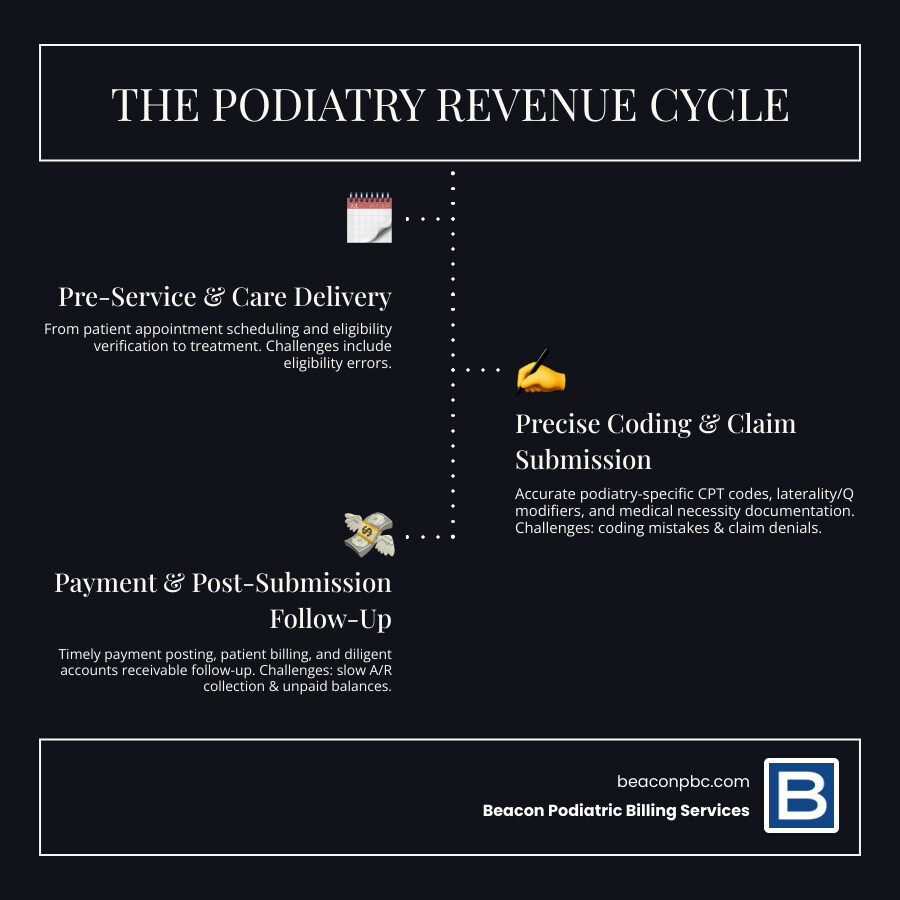
A truly high-performance solution offers end-to-end Revenue Cycle Management (RCM). This isn’t just claim submission; it’s a holistic approach that covers every stage of your revenue cycle. From verifying patient eligibility and benefits before an appointment to accurate charge capture, electronic claim submission, payment posting, and diligent accounts receivable (A/R) follow-up, an end-to-end RCM service manages it all. This comprehensive approach minimizes revenue leakage points and ensures a smooth flow of income.

A robust denial management process is another critical feature. Denials are inevitable, but how they’re handled makes all the difference. A high-performance solution doesn’t just process denials; it analyzes them, identifies root causes, and implements strategies to prevent future occurrences. This proactive and reactive approach ensures that denied claims are promptly appealed and resolved, minimizing lost revenue.
Diligent A/R follow-up means relentlessly pursuing unpaid claims from both payers and patients. This includes timely appeals, consistent communication with insurance companies, and effective strategies for collecting patient balances. Many practices struggle with A/R, letting thousands of dollars slip through the cracks. A dedicated billing partner ensures every earned dollar is captured.
Transparent reporting is essential for you to maintain visibility and control over your practice’s financial performance. A top-tier medical billing solution should provide advanced, customizable reports and dashboards that give you real-time insights into collections, denials, claim statuses, and key performance indicators (KPIs). You should always know where your money stands.
Finally, seamless EHR/EMR integration is paramount. Your billing system should effortlessly connect with your existing electronic health record system, ensuring a smooth flow of data between your clinical and billing operations. This integration reduces manual data entry, minimizes errors, and streamlines workflows, allowing your staff to focus on patient care rather than administrative duplication.
Why USA-Based Support Matters for Your Practice
In an increasingly globalized world, the appeal of cost savings from offshore services can be tempting. However, for something as critical as your practice’s financial lifeline, we firmly believe that USA-based support offers invaluable advantages that directly impact your bottom line and peace of mind. Our commitment to being 100% US-based stems from these core benefits.
First, local payer knowledge is indispensable. Healthcare regulations and insurance policies can vary not just by state, but sometimes even by region within a state. Our US-based specialists possess an intimate understanding of these localized rules, including specific Medicare LCDs and commercial payer guidelines relevant to states like New Jersey, Nevada, Nebraska, North Carolina, and Kentucky. This expertise is crucial for ensuring claims are submitted correctly the first time, avoiding costly denials and delays that result from unfamiliarity with regional nuances.
Time zone alignment might seem like a minor detail, but it dramatically improves communication and problem-solving. When your billing team operates on the same schedule as your practice, questions can be answered, issues resolved, and urgent matters addressed promptly. No more waiting until the next business day for a response, which can be critical when dealing with claim deadlines or patient inquiries.
Clear communication is another significant advantage. While many offshore teams have English speakers, subtle linguistic differences, cultural nuances, or accents can sometimes lead to misunderstandings or misinterpretations, especially when discussing complex medical and financial information. A US-based team ensures direct, unambiguous communication, fostering a stronger partnership and reducing the potential for errors.
Data security is paramount in healthcare, and partnering with a US-based entity offers a higher degree of confidence regarding compliance with stringent US regulations like HIPAA. Our operations adhere strictly to these federal laws, ensuring your patient data is handled with the utmost care and security. You have peace of mind knowing your sensitive information is protected within the same legal framework as your practice.
Finally, personalized service often thrives in a local context. We pride ourselves on building strong relationships with the practices we serve, becoming a true extension of your team. This level of personalized attention and commitment to your success is often easier to achieve when working with a partner who understands the local healthcare landscape and shares a common business culture. It’s about more than just processing claims; it’s about a partnership built on trust and shared goals.
Finding the Right Partner: Software vs. Outsourced Services
When considering medical billing solutions, practices often weigh two main options: investing in in-house billing software or outsourcing to a specialized billing service. Both have their merits, and the best choice depends on your practice’s size, resources, and specific needs. Let’s break down the pros and cons:
| Feature/Option | In-House Software (Pros) | In-House Software (Cons) “`